Choosing Outdoor Lights for Your Garden: Why the Fitting Type Matters as Much as the Position
Most garden lighting conversations focus on where the lights should go. Which tree. Which path. Which part of the boundary. These are real questions and they matter. The question that comes before them — which type of fitting is right for each location — gets less attention. And it determines more of the outcome than most homeowners realise until they’re comparing a scheme that works with one that doesn’t.
Outdoor lights for gardens aren’t interchangeable. A spotlight and a path light both produce illumination. What they produce is categorically different — in beam angle, distribution, mounting position, and the effect they create in a space. Getting the type right is what makes the position decision meaningful.
The Main Fitting Types and What Each Actually Does
Spotlights and uplights are directional — they put light precisely where they’re aimed. The ECOSPOT is the Garden Lighting Company’s spike-mount spotlight: adjustable, repositionable, suited to feature lighting of trees, specimen plants, and architectural elements. The narrow beam concentrates light and creates contrast with the surrounding darkness — which is what produces drama in a night garden.
Path lights distribute light downward and outward across a walking surface. The PATH LIGHT design sits at a height that illuminates the ground plane without creating glare at eye level. This is the functional distinction that most spike-mounted spotlights used as path lights miss — a spotlight aimed along a path illuminates it, but the beam directed toward anyone walking along it creates glare that makes the rest of the garden harder to see.
Spread lights distribute light broadly and evenly across a horizontal plane. They suit garden bed areas where overall ambient light is the goal rather than feature illumination. Think of spread lights as the fill light of a garden scheme: they lift the ambient level across planted areas so features aren’t isolated pools of light surrounded by complete darkness.
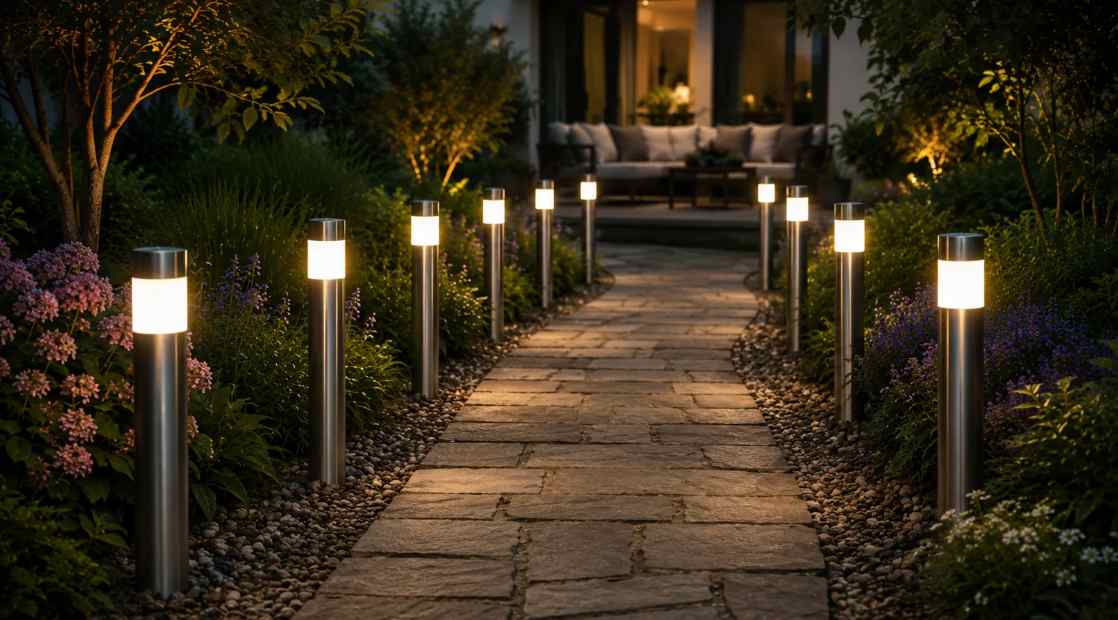
Bollard lights bring light to human height rather than ground level. Suited to path edges, entrances, and boundaries. The BOLLARD ROUND and BOLLARD SQUARE in the Garden Lighting Company range come in 390mm and 750mm heights — the height choice affects where in the visual field the light appears and how the bollard reads as an element in the garden during daylight.
Inground uplights sit flush in paving, lawn, or ground and project light upward. For trees in paved areas, or for architectural features where a surface-mounted fitting isn’t practical, inground fittings produce the same upward illumination as a spike spotlight without visible hardware above grade.
Underwater lights sit in ponds, water features, and swimming pools where light from below the water surface creates reflections and reveals depth. A water feature that goes dark at night loses the movement and sound that make it a garden focal point. Illuminated from below, it becomes the most compelling element in the scheme.
Why Mixing Fitting Types Produces Better Results Than Using One Throughout
A common approach to outdoor lights for gardens — particularly on DIY installs — is to buy one fitting type in quantity and use it throughout. Eight spotlights placed around the garden perimeter. A dozen path lights along every edge. This produces uniformity rather than composition.
A designed garden scheme uses different fitting types for different purposes, deliberately. The spotlight on the feature tree. The path light along the walking route. The spread light in the planted border. The bollard at the entrance. The underwater light in the pond. Each is doing its specific job, and the composition of those jobs together produces a garden that reads as designed rather than merely illuminated.
The IP Rating Question for NZ Gardens
Every outdoor fitting in a New Zealand garden needs to be rated for the environment it’s operating in. IP65 is the practical minimum for above-grade fittings in standard garden environments. IP67 and IP68 cover submersion, which is relevant for inground fittings in areas subject to pooling and essential for underwater applications.
Auckland’s rainfall makes this more than a theoretical specification. A fitting rated below IP65 in an Auckland garden bed is a fitting that will develop water ingress over time — not if, but when. NZ-made fittings from the Garden Lighting Company’s Moonscape range are rated and tested for NZ conditions — not certified for a different climate and assumed to work here.
Frequently Asked Questions
How do I decide between spotlights and spread lights for a garden bed?
If there’s a specific plant or feature in the bed worth highlighting, a spotlight or uplight is the right choice. If the goal is general ambient light across the planted area, a spread light achieves a more even result. Most beds benefit from a combination — one or two spotlights on key specimens, spread lights for ambient fill.
What’s the right number of path lights for a garden path?
Enough to provide continuous readable coverage without creating a runway effect. A practical starting point is every two to three metres for a standard residential path. A specialist will calculate the correct spacing for the specific fitting and path width.
Are NZ-made outdoor lights significantly better than imports?
For durability in NZ conditions, yes — particularly for UV resistance and coastal salt air tolerance. The materials and coatings specified for the NZ market account for UV intensity and humidity levels that imported products may not be designed for.
Can different fitting types run on the same transformer?
Yes — in a correctly designed low-voltage system, different fitting types can all run from the same transformer provided it’s sized for the total load. The transformer range from the Garden Lighting Company runs from 50W to 300W, covering everything from a small courtyard scheme to a larger property installation.
The Right Fitting in the Right Place
Knowing where to put outdoor lights for gardens is one decision. Knowing which fitting type to put there — and why — is what makes the scheme perform the way a well-designed garden lighting installation should.
The Garden Lighting Company has been matching the right fittings to Auckland gardens for over 40 years. NZ-made, 10-year warranty, specialist design and installation. Get in touch at gardenlights.co.nz.